#
Quick Information
Plan your visitDid you know?
Locals call it La Bombonera de Nervión, a name earned for the cauldron noise it generates on European nights.
The 1982 World Cup semi-final held here between West Germany and France was the first ever penalty shootout in World Cup history.
The stadium is named after a president who died before construction began and never saw a single brick laid.
Is the Ramón Sánchez-Pizjuán Stadium worth visiting?
Air changes as soon as you leave the museum and head toward the tunnel. One moment, you’re staring at six Europa League trophies behind glass; the next, you’re in a concrete passage with the Sevilla anthem swelling overhead and the pitch opening up in front of you.
This stadium was built to give Sevilla FC a home that matched the club’s ambition and the city’s football obsession. That purpose still shapes the visit: every room, from the presidential box to the dressing room, feels designed around match-day ritual and shared identity.
The payoff is not just seeing a stadium, but feeling how a club lives in a city. You leave understanding why Sevilla supporters talk about this ground with protectiveness, not nostalgia.
Skip it: if football culture does nothing for you, or if you want a large art museum-style attraction that fills half a day.
What to see inside the Ramón Sánchez-Pizjuán Stadium?
1/8
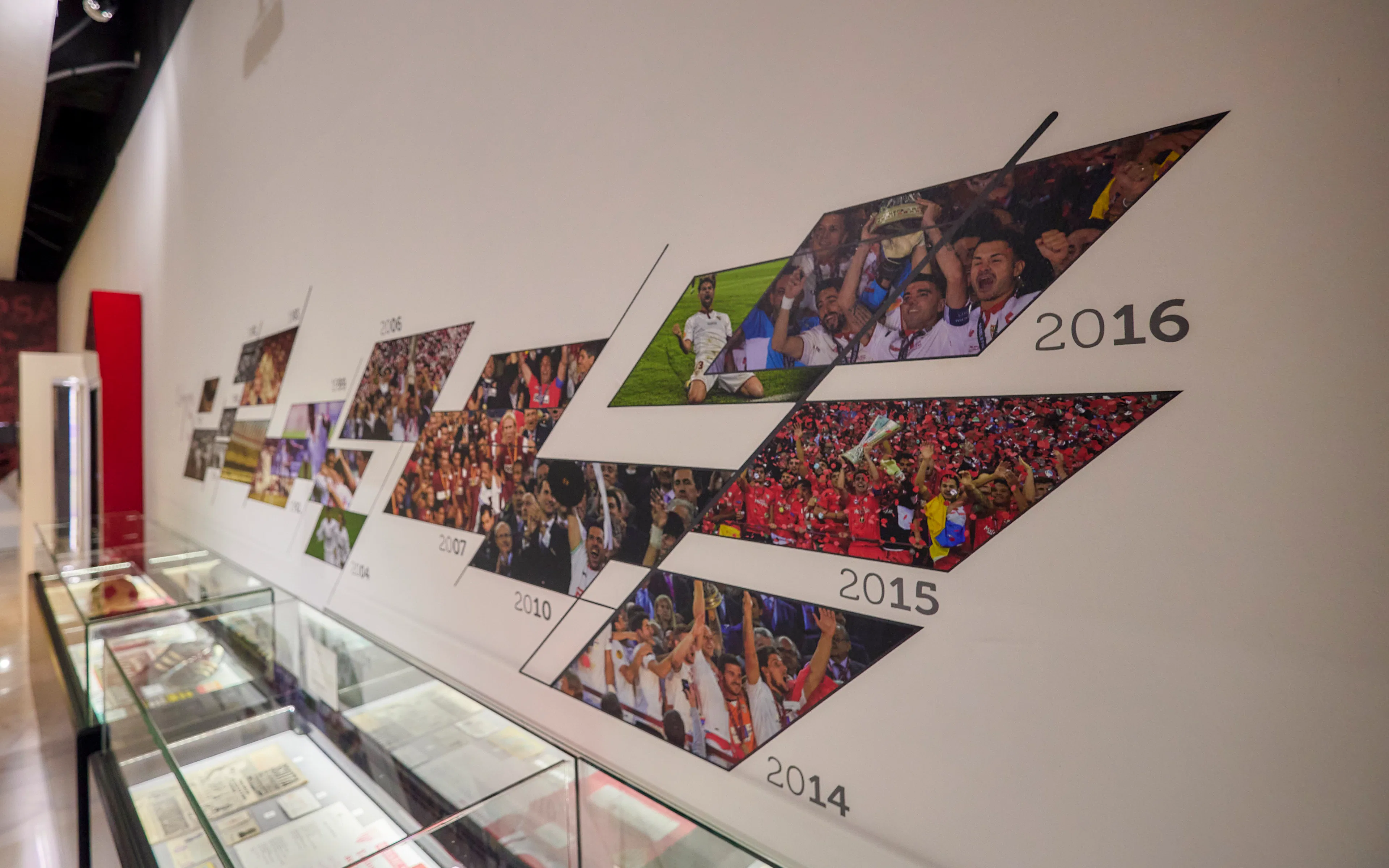
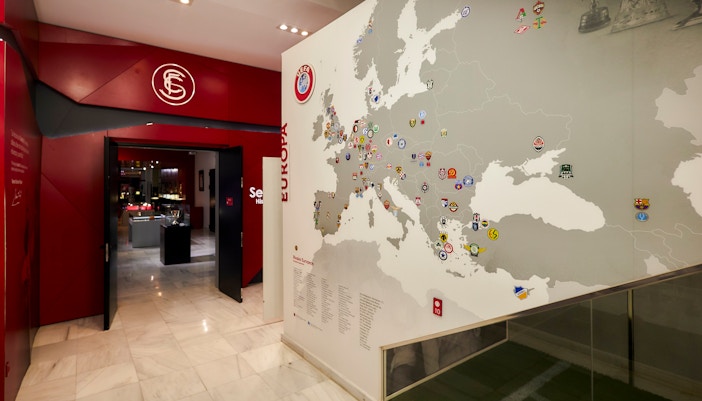
Sevilla FC History Experience Museum
The starting point. Touchscreens, original shirts and match footage trace the club from 1890 (the year Sevilla and Recreativo de Huelva played the first recorded football match in Spain, won 2-0 by Sevilla) through the Europa League dynasty.
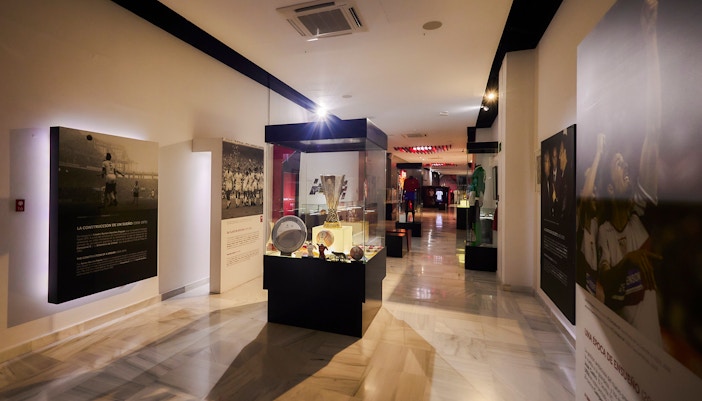
Europa League trophy display
Seven trophies behind a single glass display. No other club in the competition's history has this set. Most visitors stop here longest, and the room generates more photos than any other.
The Presidential Box (Palco)
The viewing angle reveals just how steeply the lower tier rises. Sit where the club directors watch home games, and you'll see why visiting teams describe the stadium as feeling smaller than its capacity suggests.
The Press Room
The same backdrop you've seen behind Sevilla coaches after Europa League victories. The audio guide breaks down the rituals: which seat the manager takes, where photographers stand, how the cameras get framed.
Home dressing room
Named lockers for the current first-team squad, ice baths, tactical board and physio benches. Everything is exactly as the players left it after the last home match. The most quietly surprising stop on the visit.
Players’ tunnel
This is the moment that sells the entire ticket. The Himno del Centenario plays through the speakers as you cross the threshold, the pitch opens up in front of you, and the lower tier looks like a wall. Even non-football fans go quiet here.
Dugouts and pitch-side
Sit on the home bench in the same spot as the coach. The pitch is roped off, but the proportions of the bowl from the touchline tell you everything about why this ground is loud.
Exterior Mosaic Facade
On the Preferential stand, designed by Cordoban ceramicist Santiago del Campo for the 1982 World Cup. It carries the Sevilla FC crest surrounded by around 60 small pennants of clubs that have played here, from Real Madrid and Barcelona to European visitors. In 2015, a Sevillian art historian formally petitioned for it to be declared Bien de Interés Cultural. The mosaic will be preserved in the new stadium too.
How to explore the Ramón Sánchez-Pizjuán Stadium
Budget 75 to 90 minutes for the self-paced visit. Entry is at Puerta 2, the route runs in a single linear loop, and the free audio guide downloads through an app available in 9 languages including Spanish, English, French, German, Italian, Portuguese, Arabic, Chinese and Japanese.
Suggested route: Start at the History Experience Museum to set the timeline, move through the presidential box and press room, then drop into the dressing room. Walk the tunnel as the anthem plays, and finish in the dugouts. The order matters: context first, emotional payoff at the end.
Must-see: The 7 Europa League trophies, home dressing room, tunnel walkout and dugouts. Skippable if short on time: Extended museum multimedia stations and the press room.
Insider tip: Book the late-afternoon slot. The mosaic facade glows orange in golden hour, which is why every Sevillista's favourite stadium photo seems to be taken around 5pm. You'll also dodge the mid-morning school groups.
Quick reality check: This is a self-paced visit only. There are no live guides, no scheduled group walkthroughs and no luggage storage on site, so travel light. The route is not wheelchair-accessible.
Brief history of the Ramón Sánchez-Pizjuán
- 1890: Sevilla FC is founded on 25 January, the oldest Spanish club dedicated solely to football.
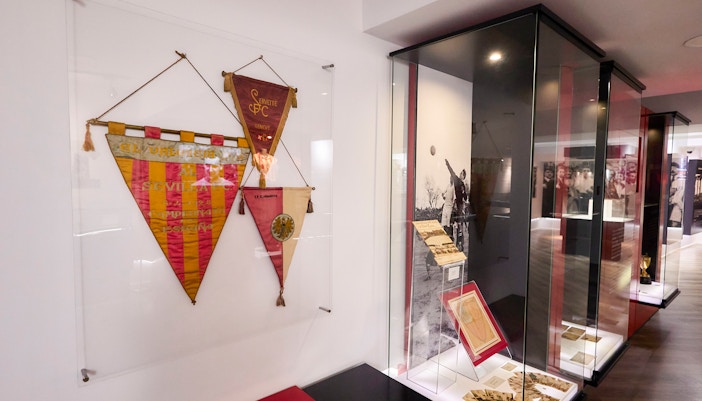
- 1937: Then-president Ramón Sánchez-Pizjuán starts acquiring land in Nervión for a stadium worthy of the club's ambition.
- 1956: Sánchez-Pizjuán dies on 28 October, almost two years before the stadium he championed opens. The foundation stone is laid that 2 December under his successor Ramón de Carranza.
- 1958: The stadium opens on 7 September with a 3-3 friendly against Real Jaén, named in honour of the late president.
- 1974-75: Second tier and end closures are added, lifting capacity to around 70,000.
- 1982: Hosts the World Cup semi-final between West Germany and France, the famous 3-3 draw settled on penalties.
- 1986: The European Cup final is played here, won by Steaua București against Barcelona on penalties.
- 2006-2023: Sevilla win 7 Europa Leagues (then UEFA Cup) and never lose a final, becoming the competition's most successful club.
- 2022: Hosts the Europa League final between Eintracht Frankfurt and Rangers.
- 2026 onwards: Capacity sits at 42,714. The current building enters its final seasons before redevelopment begins.
Architecture of the Ramón Sánchez-Pizjuán
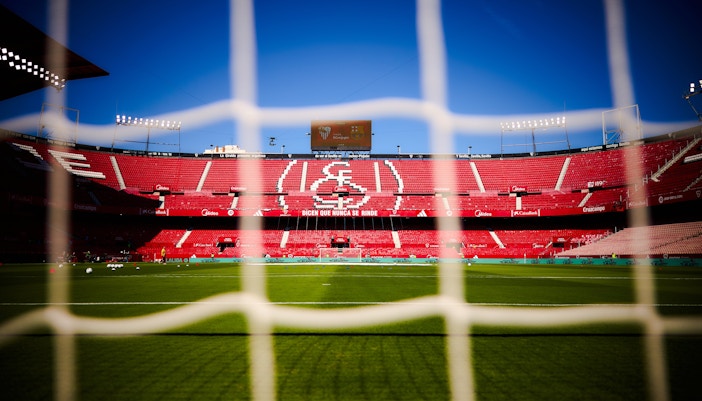
- Style: Mid-century football architecture built for noise. The stands rise almost vertically over the pitch, and the Preferential stand roof reflects sound back over the players instead of letting it dissipate. The shape is the reason the nickname stuck: La Bombonera de Nervión, the Nervión chocolate box.
- Materials: Reinforced concrete, brick and steel form the structure. The ceramic-tile mosaic on the exterior, added in 1982, gives the building its identity. The original ground required 800 concrete piles driven into soft Nervión soil before construction could begin.
- Bowl design: The four-sided seating layout sits closer to the touchline than almost any other top-flight ground in Spain. Sightlines are tight, capacity is dense, and the cumulative effect is what Unai Emery (then Sevilla's manager) once described as a "catapult" for the team.
- On the ground: From the dugout, the lower tier looks like it's leaning over you. There's almost no buffer between supporters and players, which is exactly the point.
Who built the Ramón Sánchez-Pizjuán?
Manuel Muñoz Monasterio, also linked to Real Madrid's Bernabéu, designed the stadium with structural input from James Cox. The brief was driven by Ramón Sánchez-Pizjuán himself: a ground that turned crowd noise into a tactical weapon. He died before it opened, but his name is on the building, and his ashes were laid to rest in Seville's municipal cemetery, which makes the stadium something close to a personal monument.
The end of an era at the Sánchez-Pizjuán
The current stadium is on borrowed time. Sevilla FC have approved a €350 million rebuild on the same Nervión site, designed by César Azcárate (the architect behind Bilbao's San Mamés). Demolition is set for 2027, the new 55,000-seat ground opens in 2029, and Sevilla will play at Estadio La Cartuja during construction.
The standout feature is the Gol Norte: a single-tier 15,000-seat stand nicknamed the "Muro Rojo" (Red Wall), an Andalusian answer to Dortmund's Yellow Wall. The 1982 mosaic by Santiago del Campo will be preserved and reinstalled on the new facade, alongside renewable energy systems and expanded accessibility.
What can't be rebuilt is the sound. The Himno del Centenario, written by Sevillian musician Javier Labandón ("El Arrebato") in 2005, reached number one in the Spanish charts and is sung a cappella before every home game. UEFA has called it the loudest pre-match ritual in club football. As Sevilla captain Coke once put it: "Some of our new signings don't know any Spanish, but they can still sing half of our anthem because it's so catchy."
Frequently asked questions about the Ramón Sánchez-Pizjuán Stadium
Yes, especially in the run-up to the 2027 rebuild. The original 1958 building won't be standing much longer, and the trophy wall, tunnel, and dugouts give a payoff that no other Spanish stadium visit matches.
Yes. Sevilla FC has approved a complete rebuild on the same site. Demolition is scheduled for 2027, and the new 55,000-capacity ground is expected to open in 2029. Visit before then if you want to see the original.
Most visitors finish in 75 to 90 minutes. It's a self-paced visit with a free audio guide app, so you can move as slowly or quickly as you want.
Yes, for families with children, comfortable walking 90 minutes. The route is linear and easy to follow.
The 7 Europa League trophy wall (no other club has it), the home dressing room, the players' tunnel with the anthem playing and the dugouts pitch-side.
Yes, throughout the museum, dressing room, tunnel, and pitch-side. Flash is not permitted.
More reads
History of the Ramón Sánchez-Pizjuán Stadium
Architecture of the Ramón Sánchez-Pizjuán Stadium
#
What to see inside the Ramón Sánchez-Pizjuán Stadium
#
Ramón Sánchez-Pizjuán Stadium tour tickets
#

