Palacio de las Dueñas visitor guide
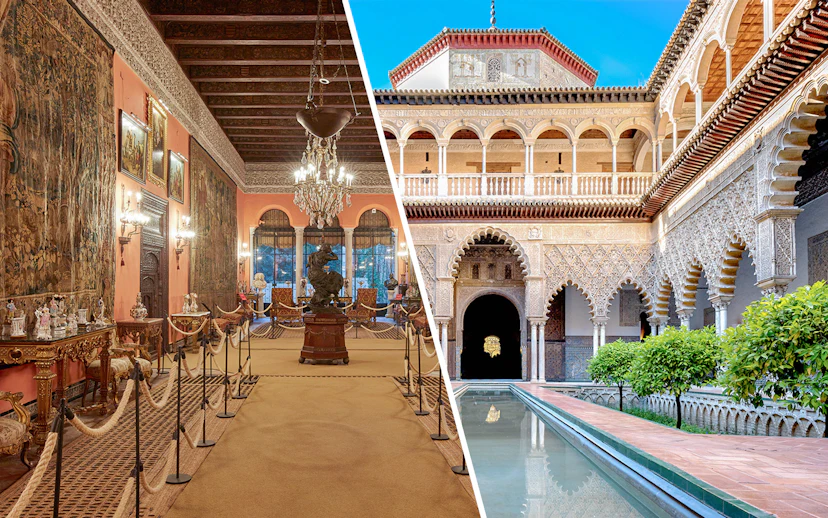
Palacio de las Dueñas is a historic palace museum in Seville best known for its aristocratic interiors, flower-filled courtyards, and ties to the House of Alba and Antonio Machado. The visit is compact rather than overwhelming, but it rewards slower pacing because the details that make it special are easy to rush past. The key difference between a good visit and a forgettable one is using the audio guide or a live tour, since room labels are light. This guide covers timings, tickets, route, and what not to miss.
Quick overview: Palacio de las Dueñas at a glance
If you want the short version before you book, this is the part that matters most.
- When to visit: Monday–Sunday: 10am–7pm from April to September, and 10am–6pm from October to March. Tuesday or Wednesday right at opening feels noticeably calmer than Monday free-entry afternoons and spring weekends, because the palace is compact and its main courtyard fills quickly once guided groups arrive.
- Getting in: From €15 for standard entry. Guided tour from €22. You can often buy same-day outside peak periods, but spring weekends, English guided tours, and free Monday slots are worth reserving a few days ahead.
- How long to allow: 1–1.5 hours for most visitors. Stretch it to 2 hours if you want the full audio guide, the art salons, and time to sit in the courtyards.
- What most people miss: The chapel and its Neri di Bicci altarpiece, plus the Machado connection in the Lemon Tree Courtyard, are the details that add real depth beyond the pretty patios.
- Is a guide worth it? Yes if you want family stories and art context, but the included audio guide is enough for a first visit if you prefer to move at your own pace.
🎟️ Guided tour slots and free Monday tickets for Palacio de las Dueñas can disappear a few days in advance during spring and October. Lock in your visit before the time you want is gone. See ticket options
Jump to what you need
🕒 Where and when to go
🗓️ How much time do you need?
🎟️ Which ticket is right for you?
🗺️ Getting around
🖼️ What to see
♿ Facilities and accessibility
🚫 Rules and restrictions
🗒️ Practical tips
🏛️ What else to visit?
🥗 Eat, shop and stay
Where and when to go
How do you get to Palacio de las Dueñas?
Palacio de las Dueñas sits on the quieter eastern side of Seville’s old town, a short walk from Metropol Parasol and about 1.3km from the cathedral area.
Calle Dueñas, 5, 41003 Seville, Spain
- Walk: Metropol Parasol → 5-minute walk → follow Calle Imagen and turn into Calle Dueñas.
- Bus: Plaza Encarnación / Imagen stops → 4–6-minute walk → easiest if you want to avoid navigating deeper old-town lanes.
- Train: Santa Justa station → 15–18-minute walk or about 5 minutes by taxi → useful for day-trippers arriving by rail.
- Taxi / rideshare: Drop-off at Calle Doña María Coronel → 1-minute walk → vehicles usually stop here because Calle Dueñas is narrow.
Which entrance should you use?
There is one public entrance on Calle Dueñas, but visitors often lose time by joining the wrong cluster in the small forecourt instead of checking whether they are already pre-booked.
- Pre-booked tickets: Main entrance desk. Best for mobile-ticket holders. Expect 0–10 minutes on most days.
- On-the-day tickets: Same entrance ticket desk. Best for flexible visits. Expect 5–20 minutes, longer on free Mondays and spring weekends.
- Guided tour check-in: Same entrance. Best for tour holders. Arrive 10 minutes early so staff can group everyone before the tour starts.
When is Palacio de las Dueñas open?
- Monday–Sunday: 10am–7pm (April–September)
- Monday–Sunday: 10am–6pm (October–March)
- Closed: January 1, January 6, and December 25
- Last entry: 45 minutes before closing
When is it busiest? Late mornings on spring weekends, Holy Week, Feria dates, and Monday free-entry afternoons feel the most crowded, especially in the main courtyard and smaller interior rooms.
When should you actually go? Opening time on a Tuesday or Wednesday gives you cooler courtyards, softer light, and more breathing room before tours and midday heat change the mood of the palace.
How much time do you need?
| Visit type | Route | Duration | Walking distance | What you get |
|---|---|---|---|---|
Highlights only | Entrance patio → Main Courtyard → chapel → Lemon Tree Courtyard → exit | 45–60 min | ~0.4km | Enough for the signature courtyards and a quick look at the chapel, but you will move fast through the art-filled salons and likely skip the stables. |
Balanced visit | Entry → Main Courtyard → state rooms → chapel → Flamenco Hall → Lemon Tree Courtyard → stables → exit | 75–90 min | ~0.7km | This is the best fit for most visitors because you get the architecture, family stories, and gardens without trying to study every artwork. |
Full exploration | Full ground-floor route → art salons → chapel → Flamenco Hall → gardens → stables → return to favorite rooms | 2+ hr | ~1km | Best if you want to use the full audio guide and linger with the paintings and furnishings, though the route is compact enough that it only pays off if you enjoy details. |
All 3 routes work on the General admission ticket with Audioguide. Choose the Guided tour for live context, not extra access.
The full route is harder without context because labels are light and the rooms feel like a private home, not a conventional museum. A guided tour helps you connect the Alba family stories, Machado references, and standout artworks without backtracking. → See guided tour options
Which Palacio de las Dueñas ticket is best for you
| Ticket type | What's included | Best for | Price range |
|---|---|---|---|
General admission ticket with Audioguide | Ground-floor rooms + patios + gardens + Audioguide | A flexible visit where you want to wander at your own pace and still understand the palace properly. | From €15 |
English guided tour | Entry + official guide in English | A first visit where live storytelling matters more than total freedom to linger. | From €22 |
Spanish guided tour | Entry + official guide in Spanish | A visit where you want deeper family and city context without relying on the app. | From €22 |
Night guided tour | After-hours entry + guided visit in Spanish | A warm-weather visit when a cooler, more atmospheric evening route is worth paying extra for. | From €25 |
Opera Boutique – Carmen at las Dueñas | After-hours visit + live performance + event seating | An evening in Seville where the setting matters as much as the show itself. | From €49 |
How do you get around Palacio de las Dueñas?
Layout and suggested route
Palacio de las Dueñas is compact and mostly linear, with the visit unfolding around a sequence of patios, salons, and garden spaces on the ground floor. In practice, that makes it easy to navigate, but also easy to rush through unless you deliberately slow down in the rooms between courtyards.
- Entry patio and Main Courtyard → the architectural centerpiece with arches, tiles, and fountain views → 15–20 minutes.
- State rooms and art salons → family portraits, furniture, paintings, and tapestry-rich interiors → 20–30 minutes.
- Chapel and Flamenco Hall → devotional art, family history, and the Duchess’s personal side → 10–15 minutes.
- Lemon Tree Courtyard and gardens → Machado connection, shade, and the palace’s most peaceful corners → 15–20 minutes.
- Stables and service areas → a more practical side of palace life with carriage and household context → 5–10 minutes.
Suggested route: Start with the Main Courtyard before tour groups build up, move through the interior rooms while your attention is fresh, then slow down in the Lemon Tree Courtyard and gardens at the end, which most people treat as a pass-through when it is actually the best place to pause.
Maps and navigation tools
- Map: There is no especially useful paper map, so use the official route on the audio guide app before arrival if you want a clearer sense of sequence.
- Signage: Wayfinding is adequate for following the route, but not strong enough to explain what you are seeing without the audio guide.
- Audio guide / app: Access it through the official app or an on-site device at entry; it adds real value because object labels are light and many rooms are domestic rather than museum-style.
💡 Pro tip: Download the audio guide before you start the route, because the rooms make more sense in sequence and it saves you doubling back once you realize what you skipped.
Where are the masterpieces inside Palacio de las Dueñas?

Main Courtyard
Attribute — Era: Gothic, Mudéjar, and Renaissance
This is the palace’s visual anchor, and the place where its mixed architectural language makes sense at a glance. Slow down for the horseshoe arches, marble columns, tilework, and the way the yellow walls catch the light. What many visitors miss is the ceiling detail above the arcades, because they stay focused on the fountain and garden beds.
Where to find it: Immediately after the entrance sequence, at the center of the public route.
Patio del Limonero
Attribute — Literary connection: Antonio Machado
This courtyard matters for more than its lemon tree and fountain. It carries the palace’s strongest emotional connection to Machado, who was born here, and it feels quieter and more reflective than the grander central patio. Most visitors photograph the tree and move on, but the real value is stopping long enough to read the Machado reference and notice how intimate the space feels.
Where to find it: Along the garden section of the route, after the interior salons.
The palace chapel
Attribute — Artist: Neri di Bicci
The chapel is small, but it holds one of the most important works on the route: Santa Catalina de Siena entre Santos. The space also shows how private devotion sat within aristocratic daily life, which is part of what makes this palace different from a standard art museum. Many visitors glance in and leave too quickly, missing the ceiling and the carved details around the altar.
Where to find it: Just off the main courtyard, on the interior part of the visitor route.
Flamenco Hall
Attribute — Cultural link: Duchess Cayetana de Alba
This room gives the palace its most personal note, because it connects the house directly to the late Duchess’s love of flamenco. The stage, photographs, and memorabilia make the palace feel inhabited rather than staged. Many people treat it as a novelty stop, but it is one of the clearest windows into how the family shaped the palace in living memory.
Where to find it: Toward the later part of the indoor route, after the main salons.
The art-filled salons
Attribute — Collection: 15th- to 20th-century works
The salons are where the palace shifts from pretty architecture to serious collection. Look for paintings tied to the Alba family’s patronage, as well as furniture, porcelain, and tapestries displayed in domestic settings rather than gallery-style isolation. The easy detail to miss is that context is part of the display here: how objects sit together tells you almost as much as the works themselves.
Where to find it: Between the main courtyard and the garden-facing spaces on the ground floor.
Stables and carriage courtyard
Attribute — Function: Working household spaces
These areas are not the most glamorous part of the palace, which is exactly why they are worth seeing. They ground the visit in the everyday mechanics of a grand residence and add balance after the ceremonial rooms and gardens. Visitors often skip them because they assume the route is effectively over by then, but they help the house feel real.
Where to find it: Near the end of the public route, beyond the garden and patio areas.
Don't leave without seeing: the chapel and the Machado references in the Lemon Tree Courtyard, both of which are easy to rush past because the main patio and garden views pull visitors forward.
Facilities and accessibility
- 🎒 Bag storage: Large bags may need to be left at the entrance area, so a small day bag makes the visit easier.
- 🚻 Restrooms: Restrooms are available on-site, and it is easiest to use them before you settle into the slower courtyard-and-salons route.
- 🪑 Seating / rest areas: Benches and places to pause are mainly in the courtyards and garden areas, not throughout every interior room.
- 📶 Wi-Fi: Wi-Fi is available to help visitors access the audio guide app on arrival.
- ♿ Mobility: Much of the public route is on one level, but gravel, tile paths, thresholds, and the historic layout mean some areas are easier with assistance, and the upper floors are not part of the visitor route.
- 👁️ Visual impairments: The audio guide is the most useful support here, because the visit relies more on narration and atmosphere than on large, easy-to-read interpretive panels.
- 🧠 Cognitive and sensory needs: Opening time is the calmest window, and the courtyards are usually the easiest spaces if you need a quieter pause away from tighter interior rooms.
- 👨👩👧 Families and strollers: Strollers can manage much of the ground-floor route, but expect a few uneven surfaces and narrower transitions between palace spaces.
Palacio de las Dueñas works best for children who enjoy gardens, fountains, and short bursts of history rather than hands-on exhibits.
- 🕐 Time: About 45–60 minutes is realistic with younger children, focusing on the courtyards, gardens, chapel, and stables.
- 🏠 Facilities: The strongest family-friendly features are the open courtyards, shaded paths, and easy places to pause rather than dedicated play areas.
- 💡 Engagement: Turn the visit into a simple treasure hunt by asking children to spot the lemon tree, fountains, horseshoe arches, and carriage-related details.
- 🎒 Logistics: Bring water before you enter, keep bags light, and aim for the first hour of opening to avoid both heat and tighter room traffic.
- 📍 After your visit: Metropol Parasol is a short walk away and gives children a change of pace after the quieter palace atmosphere.
Rules and restrictions
What you need to know before you go
- Entry is by standard ticket, guided tour booking, or reserved free Monday slot, and reduced tickets require ID or supporting proof at the door.
- Large bags may need to be left at the entrance, so traveling light makes security and circulation easier.
- Re-entry rules are not a selling point here, so it is smartest to treat the visit as one continuous loop and handle water or restroom stops before you leave.
Not allowed
- 🚫 Food and drink are best kept outside, since this is a historic house museum with delicate interiors and collections.
- 🚬 Smoking and vaping are not part of the visitor route inside the palace spaces and courtyards.
- 🐾 Pets are not part of a standard visit, though service animals should be cleared in advance if needed.
- 🖐️ Touching furniture, artworks, tilework, or architectural details is not allowed because many pieces remain in fragile original settings.
Photography
Photography is generally allowed in the courtyards, gardens, and most rooms, but flash should be avoided to protect artworks and interiors. The practical distinction is that open-air spaces are the easiest places to shoot freely, while smaller rooms and special event setups may carry tighter instructions from staff. Tripods and bulky photo gear are not a good fit for the route, and performance nights can have stricter no-photo rules.
Good to know
- Only the ground floor, courtyards, gardens, and related public rooms are part of the visit, because the family still maintains private residential areas upstairs.
- Free Monday entry still requires online reservation, and those slots can disappear faster than regular paid tickets.
Practical tips
- Book guided tours and free Monday tickets a few days ahead in spring and October, because those specific slots disappear faster than standard self-guided entry.
- If you are joining a guided tour, arrive at least 10 minutes early, since the small forecourt gets crowded and latecomers can spend the first part of the tour sorting out check-in.
- Don’t burn all your time in the first courtyard: the chapel, Flamenco Hall, and quieter salons are what turn this from a pretty stop into a memorable one.
- The best crowd-management move here is a Tuesday or Wednesday opening-time visit, because the palace is compact and feels much busier once guided groups start moving through the same rooms.
- Bring your own wired or wireless earbuds if you plan to use the audio guide on your phone, because listening room by room is far easier than holding your device throughout the route.
- Keep your bag small, since a larger backpack can slow entry and may need to be left near the entrance anyway.
- Eat before or after the visit rather than planning around it, because there is no on-site café and nearby options like El Rinconcillo are more satisfying than squeezing in a rushed break.
What else is worth visiting nearby?
Commonly paired: Casa de Pilatos
Casa de Pilatos
Distance: 750m — 10-minute walk
Why people combine them: It is Seville’s most natural same-day palace pairing, letting you compare 2 aristocratic houses with very different scale and mood in a single afternoon.
Commonly paired: Metropol Parasol
Metropol Parasol
Distance: 400m — 5-minute walk
Why people combine them: It works well before or after Dueñas because it adds rooftop city views and a modern contrast to the palace’s historic interiors.
Also nearby
Palace of the Countess of Lebrija
Distance: 700m — 9-minute walk
Worth knowing: It is smaller than Dueñas, but its Roman mosaics and house-museum feel make it a strong follow-up if you enjoy private collections in lived-in spaces.
Basílica de la Macarena
Distance: 1.2km — 15–18-minute walk
Worth knowing: This is a good choice if you want to connect palace culture with Seville’s devotional side and explore a less tourist-heavy part of the old city.
Eat, shop and stay near Palacio de las Dueñas
- On-site: There is no café or vending inside Palacio de las Dueñas, so treat nearby bars and coffee spots as part of your plan rather than a backup.
- El Rinconcillo (2-minute walk, Gerona 40): Classic Sevillian tapas in one of the city’s oldest bars, and the easiest post-visit stop if you want atmosphere as much as food.
- La Cacharrería (7-minute walk, Regina 14): Good for coffee, toast, and a lighter breakfast before an opening-time visit.
- Perro Viejo Tapas (6-minute walk, Arguijo 3): A practical sit-down option near Las Setas if you want a fuller meal without straying far.
- Pro tip: Eat either before 1:30pm or after 3:30pm if you are heading to El Rinconcillo, because standard Spanish lunch hours make the easy nearby choices feel much busier than the palace itself.
- Mercado de la Encarnación: Good for produce, snacks, and a quick local-food browse near Metropol Parasol if you want something casual after the visit.
- Calle Regina boutiques: Independent fashion, ceramics, and small local design shops make this the most useful nearby stretch if you want something more characterful than chain-store shopping.
This part of Seville is a smart base if you like being in the old town without the full intensity of Santa Cruz. It is walkable, locally flavored, and close enough to major sights, though first-time visitors who want the postcard version of Seville right outside their hotel may prefer to stay a little farther south.
- Price point: Mid-range with some good-value boutique stays, usually less inflated than the busiest cathedral-adjacent streets.
- Best for: Visitors who want a quieter old-town base, easy walking access to Dueñas, Las Setas, and tapas bars, and fewer crowds right outside the door.
- Consider instead: Santa Cruz or El Arenal if you want the cathedral, Alcázar, and classic first-time Seville atmosphere within a shorter walk.
Frequently asked questions about visiting Palacio de las Dueñas
Most visits take 1–1.5 hours, though art lovers can easily stretch it to 2 hours. If you use the full audio guide, pause in the gardens, and spend time in the salons instead of only photographing the courtyards, the longer end feels more realistic.
No, you do not always need to book ahead, but it is smart to reserve spring dates, English guided tours, and free Monday slots in advance. Standard self-guided tickets are often still available close to the day, while the more limited timed experiences disappear first.
Usually no, unless you are visiting on a busy spring weekend or you want the certainty of a pre-booked slot. This is not a site with Colosseum-level queues, but pre-booking still saves time at the ticket desk and matters more for guided tours than for standard entry.
Arrive about 10 minutes early for a guided tour and 5–10 minutes early for standard entry if you already have a ticket. That gives you enough time to scan your booking, sort out the audio guide, and avoid starting the visit in a rush.
Yes, but keep it small if you can. Larger bags may need to be left near the entrance, and a compact day bag is easier in the narrower palace rooms and around delicate furnishings.
Yes, photography is generally allowed in the courtyards, gardens, and most public rooms, but flash is best avoided. Special events can carry stricter rules, and this is not the place for tripods or bulky photo setups.
Yes, you can visit with a group, and official guided tours are the simplest format if you want everyone moving together. Smaller groups work especially well here because the palace is intimate and some rooms feel crowded once too many people gather at once.
Yes, if your children enjoy gardens, fountains, and short history visits rather than interactive exhibits. Most families do best with a 45–60-minute route focused on the courtyards, Lemon Tree Courtyard, and stables rather than every room on the audio guide.
Partly, yes: much of the public route is on one level, but uneven surfaces and thresholds still matter. The courtyards and ground-floor route are the accessible core of the visit, while upper private areas are not part of standard access anyway.
Food is available nearby, but not inside the palace itself. El Rinconcillo is the closest classic option, while the Las Setas area gives you more cafés and casual choices within a 5–7-minute walk.
Yes, Monday afternoon entry is free on non-holiday Mondays, but you still need to reserve a slot online. These tickets are limited, carry a small booking fee, and are often claimed faster than regular paid entry during busy periods.